Sign up for a free account to read this case study and download the full PDF.
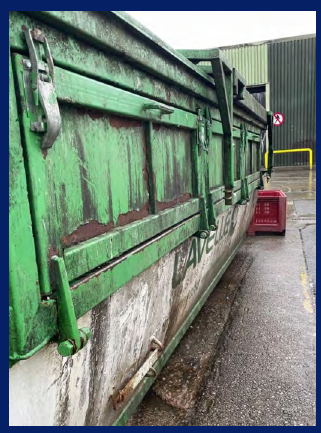
On 15 April 2024, an employee at Greenhalgh's Craft Bakery Limited in Lostock, Bolton, suffered a serious injury while carrying out an apparently routine task: disposing of food waste into a skip. The employee needed to reach the top of the skip to put the waste inside, but suitable access equipment had not been provided.
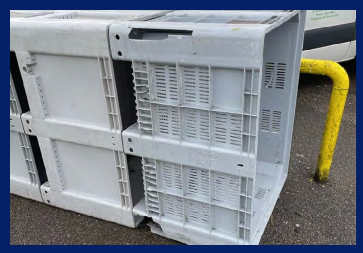
Instead, the worker stood on top of a large plastic pallet box to gain the additional height needed to reach the skip. While standing on the box, the employee fell and fractured their hip.
What might initially appear to be a straightforward slip or fall was subsequently investigated by the Health and Safety Executive (HSE). The investigation identified much wider problems with the way the activity had been planned and managed.
What had gone wrong?
The HSE investigation found that Greenhalgh’s Craft Bakery had failed to carry out a suitable and sufficient risk assessment for loading the skips. This was significant because a suitable assessment should have identified that employees needed to gain additional height to deposit waste into the skip. Once that need had been identified, the employer could have considered a safer way of completing the task. Instead, workers were able to use the plastic pallet box as an improvised platform. The company had also failed to provide appropriate equipment to allow employees to access the
skip safely. The problem therefore went beyond the actions of the individual employee. The HSE also found that there had been inadequate supervision and monitoring, allowing unsafe working-at-height practices to become commonplace.
In other words, this was not simply a worker making a poor decision on one occasion. An unsafe method of working had been allowed to develop and become part of the normal way in which the task was performed.
The risk assessment failure
This case demonstrates why even routine and apparently low-risk activities need to be considered as part of the risk-assessment process. A basic assessment of the task might have asked:
• What do employees have to do to get waste into the skip?
• Can they reach the opening safely from ground level?
• Are they likely to climb or stand on anything to reach it?
• What could they fall from?
• What injuries could result from a fall?
• Is suitable access equipment available?
• Are employees actually following the intended safe system of work?
• Is the task being supervised and monitored?
Had these questions been considered properly, the danger associated with workers standing on an unsuitable plastic box should have been foreseeable.
The risk assessment could then have led to practical controls such as changing the waste-disposal arrangement, providing suitable access equipment, establishing a safe method of loading the skip and ensuring employees were instructed and supervised appropriately.
The legal consequences
Greenhalgh’s Craft Bakery Limited pleaded guilty to breaching Section 2(1) of the Health and Safety at Work etc. Act 1974. This requires employers, so far as is reasonably practicable, to ensure the health, safety and welfare of their employees.
At Tameside Magistrates’ Court on 13 March 2026, the company was:
Fined: £16,667
Ordered to pay costs: £4,333.66
Victim surcharge: £2,000
The financial consequences therefore exceeded £23,000, in addition to the human consequences of the employee suffering a fractured hip.
What can we learn from this incident?
One of the most important lessons is that risk assessments should reflect how work is actually being carried out, not simply how managers believe it is being carried out. If employees regularly improvise a solution to complete a task, that behaviour may indicate a problem with the design of the task itself.
In this case, standing on a plastic pallet box was an obvious unsafe behaviour. However, simply telling the employee not to stand on the box would not necessarily address the underlying problem: "How were workers supposed to get the waste into the skip safely?"
The case also demonstrates the importance of supervision and monitoring. A risk assessment is not effective simply because it exists as a document; managers need to check whether the identified controls are actually being followed and whether different working practices have developed over time.
As HSE Inspector Leanne Ratcliffe emphasised following the prosecution, employers need to identify work-at-height activities, provide safe access and have systems of supervision and monitoring capable of identifying and preventing unsafe practices. (HSE Media Centre)
Applying this to your workplace
Think about your workplace Consider the routine activities within your own organisation. Are there tasks that appear so ordinary that nobody has really considered how they are being completed? Look particularly for situations where workers have developed their own shortcuts or workarounds, such as standing on boxes, climbing on furniture, using unsuitable equipment, moving heavy objects manually, bypassing equipment or improvising access arrangements. These behaviours can be warning signs that the existing risk assessment or control measures do not reflect the reality of the job.
Key takeaway
The accident did not happen because disposing of food waste is inherently dangerous. It happened because the way the task was being carried out exposed the worker to an unnecessary risk of falling.
A relatively simple task therefore resulted in a fractured hip, an HSE investigation, prosecution and more than £23,000 in fines, costs and surcharge. The case is a strong reminder that effective risk assessment is about looking closely at how people actually perform everyday tasks, identifying
unsafe practices before somebody is injured, and putting practical controls in place.
Sources
Health and Safety Executive (HSE) (2026), Bakery company fined after employee suffers hip fracture in fall.